
Nampa City Directory Runs
Nampa has no single, continuous shelf of books bearing only the city's name. The strongest verified run is regional. Some titles cover four southwest Idaho counties, while later Caldwell-centered books expressly include Nampa and other Canyon County communities. A catalog year confirms a held volume or reel, not that every page is online or that every resident appears.
| Collection | Years | Where Held | Access |
|---|---|---|---|
| Four-county directory | 1930–31, 1936–37 | Idaho State Archives, Reel 23 | Microfilm, reading room, or research request |
| Caldwell-centered Nampa-inclusive books | Selected years, 1945–1971 | Idaho State Archives, Reels 24–25 | Archive access; coverage wording changes after 1964 |
| R.L. Polk bibliography trail | 1915, 1919–20, 1930–31, 1945 | Historic-district bibliography and archives | Verify Nampa pages on microfilm |
| Nampa telephone books | Selected years, 1952/53–2001 | University of Idaho Special Collections | Incomplete repository holdings |
| NARA county directories | 1921–22, 1925–26, 1930–31 | National Archives | Reading-room or regional-facility microfilm |
The Idaho State Archives holdings list is the best first inventory. It supplies reels and dates before a request. No authoritative source established the first Nampa-only edition or the final printed year, so those dates remain open.
Why Nampa Directories Are Regional
Canyon County was formed in 1891 with Caldwell as county seat, the same year Nampa incorporated. That civic geography helps explain the catalog titles. Nampa households may sit inside a multi-county directory or a Caldwell-centered volume instead of a book labeled simply “Nampa.” Check the contents, city heading, and place index before deciding a name is absent.
The National Archives circa-1930 inventory independently lists three county directory runs that include Nampa. It overlaps the State Archives catalog but offers another access route. Record the title, year, reel, repository, and whether the evidence came from a catalog record or an actual page image.
R.L. Polk and Company is confirmed for the locally cited 1915, 1919–20, 1930–31, and 1945 runs. Publisher information is not established for every issue. This matters because abbreviations and internal indexes can vary by publisher and year.
Reading a Nampa Directory Entry
A Nampa city directory entry can carry far more than a surname. The inspected Polk trail shows initials or a full given name, a spouse in parentheses, a short occupation, an office address, and a separate home address. Another line may mark a widow, rural delivery, or service affiliation. Read the whole line and any continuation before copying an address.
| Name | Surname, given name or initials; a spouse may appear in parentheses. |
|---|---|
| Occupation | A term such as phtgr, with an employer or office address when printed. |
| Residence | A marker such as h or r, followed by the period street form. |
| Status | A widow, military, or rural-delivery abbreviation may refine the match. |
| Second address | Often an office or business location, not a second household. |
- Criss-cross directory
- A volume or section arranged by street address instead of surname. Confirm the chosen reel contains one.
- Householder index
- An address-led list of household names that may omit relatives and unlisted people.
- Abbreviation key
- The publisher's code list for work, spouse, home, residence, and “same as above.”
The code do often means “same as above,” while wid marks a widow or widower. The original volume key controls. Never expand an unclear code from memory when a reel can settle it.
Nampa Library Directory Research
The Nampa Public Library Local History Area is on the third floor at 215 12th Avenue South. It offers local-history material, a microfilm reader, and a newspaper kiosk. Posted hours are Monday through Thursday 10 a.m. to 8 p.m., Friday 9 a.m. to 6 p.m., and Saturday 10 a.m. to 5 p.m. Staff can also arrange a local-history tour.
The collection policy allows directories and published Nampa and Canyon County documents, but the public pages do not state the exact directory years on the shelf. Ask for shelf-level holdings before traveling. A useful request names the person, likely year, street, and desired title.
The Nampa Library digital collections search supports keywords, fields, collections, types, tags, and geography. No digitized Nampa city directory was located there. The image below shows the actual search surface for photographs and oral histories, not a scanned directory shelf.
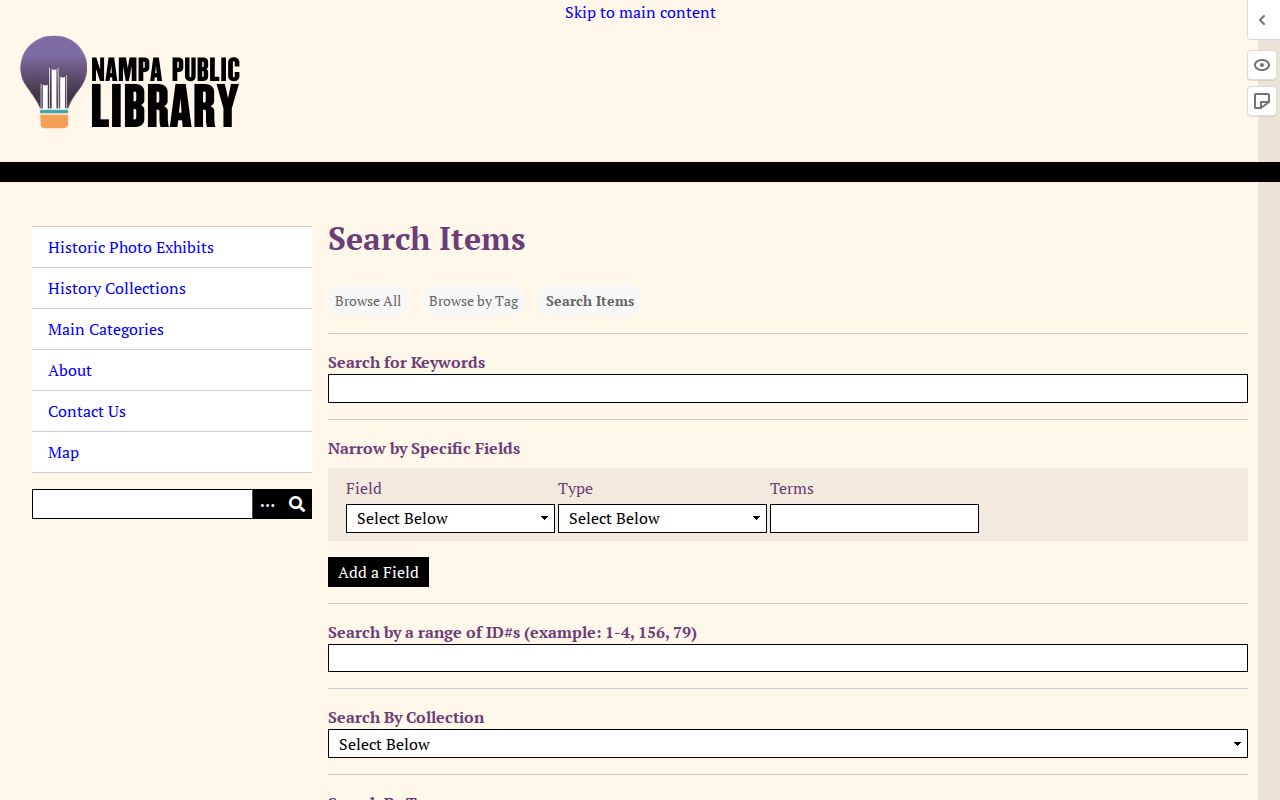
A result supplies community context. The printed entry still needs to be checked in the archive volume or microfilm.
Nampa Telephone Books Bridge Gaps
The University of Idaho directory holdings list Nampa telephone books for 1952/53, 1953–54, 1984–85, 1988/89, 1993/94 through 1996, and 1998 through 2001. Business directories are listed for 1971–75, 1981, 1985, 1986/87, and 1988. These runs help when no resident directory survives for the target year.
A telephone book may tie a surname to a number, business, or street, but it is not a full household roll. Unlisted subscribers disappear. A business number may point to an office rather than a home. Treat each listing as a dated clue and compare it with the volumes on either side.
Trace Nampa Families by Year
City directories work best as one part of a dated chain. Start from a known person and year, then move in small steps. A spouse, middle initial, occupation, or street can distinguish two people with the same name. Nampa entries may also use rural routes, fractional addresses, or a work address beside the home, so copy the wording exactly.
- Choose the closest verified Nampa-inclusive volume and search surname variants, initials, spouse markers, and widow markers.
- Check the next available year in both directions. Note moves, occupation changes, disappearances, and spelling shifts.
- Compare the entry with the nearest released federal census year, allowing for different boundaries and dates.
- Use a telephone book to bridge gaps, then test the address in a deed, map, obituary, or newspaper notice.
- Record the repository, title, year, reel, page, and whether the item is an index, transcript, or image.
A directory may list only a head of household, subscriber, or business. It does not prove that every relative lived there. The Nampa Street Directory handles current parcel records and modern address forms.
Nampa Newspapers Fill Missing Years
Local newspapers can explain why a directory name appears, changes, or vanishes. The State Archives list includes scattered issues of the Nampa Progress from 1889 to 1895 and the Nampa Leader from 1898 to 1904. The Nampa Leader-Herald runs from late 1904 into 1930, while the Idaho Free Press extends from 1919 to 1980 in the listed microfilm coverage.
Search obituaries, marriage notices, legal notices, social columns, and property advertisements around the directory date. Early titles have gaps, so a failed date search does not prove that no notice ran. Nampa Library's kiosk may provide local access, while the State Archives holds the formal inventory.
Use a newspaper to test a change already seen in a printed volume. An obituary can connect relatives. A legal notice may point to a court or recorder file. Neither proves who occupied a house on an unlisted date.
Nampa Maps Add Address Context
Sanborn fire-insurance maps show buildings, streets, construction details, rail lines, and industrial uses rather than resident names. Verified Nampa items exist for 1892, 1907, and 1949. Pair the closest map with the printed address to see whether a structure or street form existed.
This is valuable near Nampa's railroad core. Old listings may refer to a depot, freight house, canal, creamery, sugar operation, or rural route instead of a modern address. Historic photographs and Centennial oral histories can add a business or place name that leads back to the printed book.
Maps establish physical context, not occupancy. Note the sheet and year, then attach a person only when a directory, newspaper, deed, or other dated name source supports the link.
Nampa City Directory Timeline
Nampa's directory record grows from the region's rail, county, and civic history. The sequence explains why early people searches often need newspapers, maps, school minutes, or business notices rather than a neat municipal volume.
| Year | Research milestone |
|---|---|
| 1883 | Oregon Short Line reaches the area and creates early railroad records. |
| 1886 | Nampa townsite company forms. |
| 1891 | Nampa incorporates and Canyon County is created. |
| 1908 | The city library opens after the Woman's Century Club's work. |
| 1915 | Earliest bibliography-confirmed Polk run found in the research. |
| 1930–31 | State Archives and NARA both document a Nampa-inclusive directory. |
| 1945–1971 | Selected Caldwell-centered books include Nampa and county coverage. |
No official source establishes the last printed Nampa city directory. Keep that gap visible and ask the repository about later telephone-based or uncataloged runs.